

Microwave peanut brittle is the easiest candy you’ll make this Christmas. One glass bowl, about 8 minutes of cooking, and no candy pot to scrub.
Here’s the honest catch:, the timing in most microwave peanut brittle recipes only works in the microwave it was written for. That’s why the comments under the popular versions are full of burnt batches and brittle that never hardens.
So I read through the comments on five of the most popular microwave peanut brittle recipes and built this one to fix what kept going wrong.
It comes with a wattage chart, a quick done-ness check, and a fix for every problem readers ran into.
Why Microwave Peanut Brittle Burns (or Stays Sticky)

Almost every failed batch comes down to one of three things.
Your microwave is stronger or weaker than the recipe’s. A timer written for a 1,000-watt microwave will scorch sugar in a 1,500-watt one. Older microwaves also lose power over time, so the same recipe can burn in a brand-new microwave and come out perfect in a 20-year-old one.
The sugar never got hot enough. Peanut brittle has to reach the hard crack stage, 300 to 310°F. Below that, you get chewy, sticky candy that never snaps.
It’s humid. Sugar pulls moisture out of the air. On a muggy day, even a perfectly cooked batch can turn tacky.
Fix those three and microwave peanut brittle is about as close to foolproof as candy gets.
Ingredients for Easy Microwave Peanut Brittle
- Granulated sugar. Plain white sugar. Sugar substitutes don’t caramelize the same way, so skip them here.
- Light corn syrup. Karo is just a brand name for it. Corn syrup keeps the sugar from turning back into crystals, which is what gives brittle that smooth, glassy look. Measure it exactly. One reader who used half the corn syrup ended up with burnt sugar and a cracked bowl.
- Roasted salted peanuts. They’re already roasted, so they bring a deeper nutty flavor and only need a few minutes in the hot sugar. Using raw peanuts? Raw-peanut versions add them at the very start so they cook longer, but a pastry chef points out that hot syrup won’t give raw peanuts a true roasted flavor. Roasting them first at 350°F for about 10 minutes fixes that.
- Butter. Just 1 1/2 teaspoons. Teaspoons, not sticks.
- Vanilla extract. For that warm, bakery smell.
- Baking soda. This is what makes brittle light and crunchy instead of rock hard. Don’t add extra. Too much can taste soapy and turn the brittle crumbly.
The Right Bowl Matters More Than You Think
The sugar in this recipe gets hotter than 300°F, so the bowl is not the place to improvise.
- Use heatproof glass, not plastic. One reader’s “microwave-safe” plastic bowl started to melt.
- Go bigger than you think. A 2-quart glass batter bowl or large measuring bowl gives the foam room to rise. A reader who started in a 1-quart cup had to move the hot candy to a bigger bowl, and it hardened on the way.
- Pick one with a handle. Pouring out of a smooth, super-hot bowl is the hardest part of the whole recipe. A handle and a pair of oven mitts make it safe.
- Stir with a wooden spoon. One reader’s rubber spatula melted in the hot sugar.
- Never shock hot glass. Don’t set the hot bowl on a cold or wet counter, and never add cold water to it. A sudden temperature change can crack or shatter glass. Set it on a folded towel or wooden cutting board instead.
Find Your Microwave Wattage First
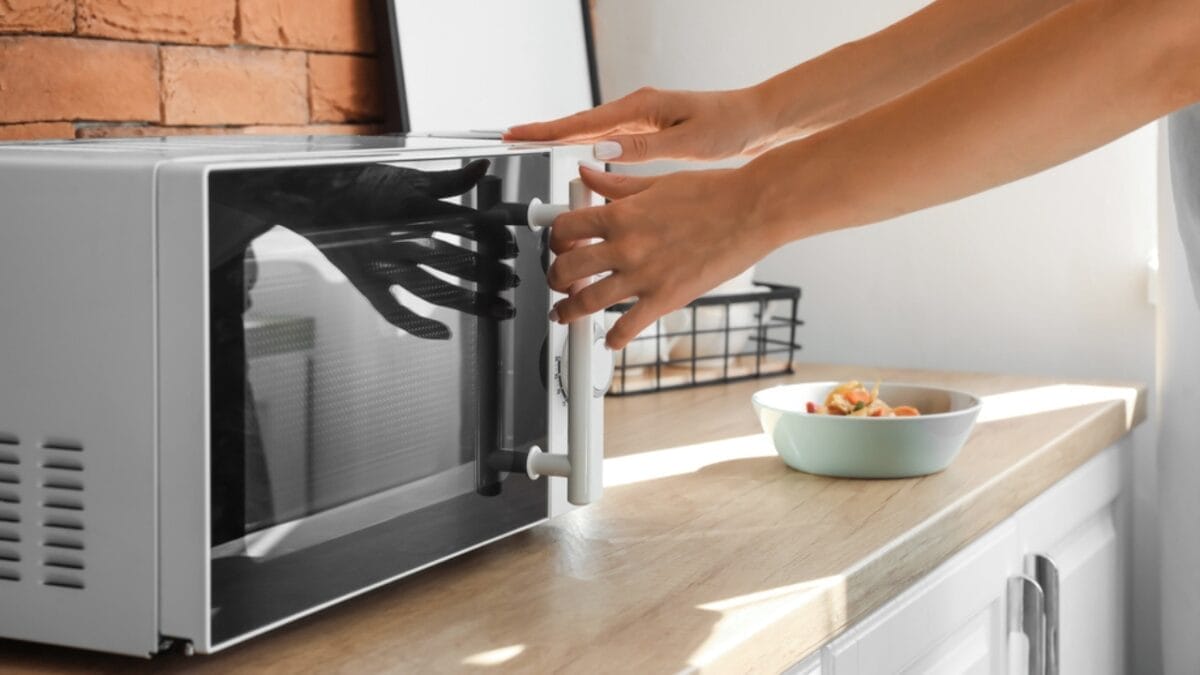
Look for a label inside the door, on the back, or in the manual. Many labels list two numbers, and you want the outputwatts, not the power consumption. One recipe developer’s test microwave was rated 1,600 watts of consumption but only 1,200 watts of output.
If your microwave is old, expect it to run a little weaker than its label says.
Microwave Peanut Brittle Wattage Chart
| Microwave output | Sugar + corn syrup | After adding peanuts | After adding butter + vanilla | Where this comes from |
|---|---|---|---|---|
| 1,000 watts | 3 1/2 min | 3 min | 1 1/2 min | The base recipe’s tested times |
| 1,500 watts | 2 min 45 sec | 2 min | 1 min 10 sec | A reader who made 3 batches in a row with these times |
| 1,100 watts | Use the 1,000-watt times at 90% power | Estimated with the power-level method below | ||
| 1,200 to 1,300 watts | Use the 1,000-watt times at 80% power | Estimated with the power-level method below | ||
| 1,400 watts | Use the 1,000-watt times at 70% power | Estimated with the power-level method below | ||
| Under 1,000 watts | Use the 1,000-watt times at full power, then add 30-second bursts | Expect it to need more time |
The power-level method: instead of guessing new times, lower your microwave’s power level so it acts like a 1,000-watt microwave, and keep the same times. One family’s recipe works this way: 70% power on an 1,100-watt microwave, or full power on a 700-watt one.
Treat any estimated row as a starting point. The done-ness check below has the final say every time.
How to Make Peanut Brittle in the Microwave

Before you start: grease a large baking sheet well with butter or nonstick spray. Never use wax paper; the hot candy melts the wax right into the brittle.
Want a little more time to spread? Warm the greased pan in a 175°F oven while you cook. Measure every ingredient and set it next to the microwave, because the last two steps move fast.
- Cook the sugar. In your glass bowl, stir together the sugar and corn syrup. Microwave on high for 3 1/2 minutes (1,000 watts). It will be bubbling and clear.
- Add the peanuts. With oven mitts, take out the bowl and stir in the peanuts with a wooden spoon. Microwave 3 more minutes, until the syrup turns light golden.
- Add the butter and vanilla. Stir them in until the butter melts. Microwave 1 1/2 more minutes.
- Do the done-ness check. (See the next section.) If it isn’t there yet, microwave in 30-second bursts and check again.
- Add the baking soda. Sprinkle it over the top and fold gently, just until it disappears. The candy will foam up and turn lighter in color. Don’t keep stirring.
- Pour right away. Pour it onto the greased pan and tilt the pan to spread it, or nudge it with a greased spatula. Aim for 1/4 to 1/2 inch thick. Spread it less for airier brittle, or thinner for the classic snap.
- Cool, then break. Let it cool completely, 30 to 60 minutes. Then break it into pieces with a kitchen mallet or the back of a heavy spoon.

How to Tell When Microwave Peanut Brittle Is Done
This is the step every failed recipe skips. A timer only gets you close. This is how you know.
Check the color. You want a deep golden, caramel color, like honey held up to the light. Dark brown with a burnt smell means it went too far.
Check the temperature. Take the bowl out of the microwave first, then check with a candy or instant-read thermometer. You’re looking for 300 to 310°F. Never leave a metal thermometer in the microwave. If your batches tend to run dark, one reader found the candy kept climbing after the timer ended, so she started pulling it 10 to 15 degrees early.
No thermometer? Use the cold-water test. Drop a little of the hot syrup into a glass of very cold water. At hard crack, the strands harden right away and snap cleanly. If they bend or feel sticky, it needs more time.

Why Baking Soda Makes Peanut Brittle Light and Crunchy
As the sugar cooks and turns amber, it builds up small amounts of acid. Baking soda is alkaline, so when it hits the hot candy, the two react and release carbon dioxide.
That’s the same gas that makes bread rise. The bubbles get trapped as the candy hardens, and that honeycomb of tiny air pockets is what makes brittle shatter instead of breaking your teeth.
That’s also why two small habits matter:
- Add the soda as soon as the candy is ready. If you wait, the sugar keeps cooking and can burn.
- Fold, don’t beat. Stirring hard knocks the bubbles out, and the brittle comes out thin and rock hard.
Why Is My Peanut Brittle Sticky?
It didn’t reach 300°F. This is the most common reason. Unfortunately, a batch that set up soft usually can’t be fixed. Next time, use the done-ness check before adding the baking soda.
It’s a humid day. Brittle absorbs moisture from the air and won’t set crisp. Make it on a cool, dry day when you can. If you have to make it when it’s muggy, cook it to the top of the 300 to 310°F range.
It was stored warm or in the fridge. Packing brittle before it’s fully cool traps steam, and the fridge adds condensation. Both turn crunchy brittle chewy.
Why Did My Peanut Brittle Burn?
- Your microwave runs stronger than the recipe’s. Check the wattage chart and lower the power level.
- There wasn’t enough corn syrup. Measure it exactly.
- The peanuts went in too early. Roasted peanuts only need the second cook. Adding them at the start can scorch them.
- You waited too long to add the baking soda. The candy keeps cooking in the hot bowl.
- You doubled the batch. See below.
Can You Double Microwave Peanut Brittle?
Make two separate batches instead. Doubling changes the timing, raises the risk of a boil-over, and two of the recipe developers I looked at both recommend separate batches. One batch goes fast anyway.
How to Clean the Bowl the Easy Way
That hardened candy in the bottom of the bowl looks permanent, but it isn’t. Let the bowl cool down, then fill it with hot, soapy water. The sugar dissolves on its own.
Making batches back to back? Longtime brittle makers melt the leftover candy out with very hot water, dry the bowl and spoon, and start the next batch. Just never pour cold water into hot glass.
How to Store Peanut Brittle
Keep it in an airtight container at room temperature, somewhere cool and dry, with parchment between the layers so the pieces don’t stick together.
Stored that way, it keeps for a few weeks. Never refrigerate it.
Peanut Brittle for Christmas Gifts
Homemade peanut brittle is one of the easiest Christmas candy gifts you can make, and one batch makes roughly a pound.
Break it into bite-size pieces, pack it in tins or cellophane bags with a sheet of parchment, and tie it with ribbon.
A few ideas from readers who make it every year:
- Make it festive. Stir a few drops of red or green food coloring in right before the baking soda.
- Swap the nuts. Cashews and pecans both work. Roasted, salted nuts go in during the last minute of cooking so they don’t burn.
- Add chocolate. Scatter chocolate chips over the top right after you pour.
Prefer the classic stovetop method? Try my Simple Peanut Brittle Recipe for Beginners.
Once you know your microwave’s sweet spot, write the times on a sticky note and tape it inside a cabinet door. Every batch after that takes about 15 minutes, start to finish, plus cooling, and you’ll have a holiday candy tin ready before the cookies are even out of the oven.

Easy Microwave Peanut Brittle
Equipment
- 2-quart heatproof glass bowl with a handle
- Wooden spoon
- Large baking sheet
- Oven mitts
- candy or instant-read thermometer (recommended)
Ingredients
- 1 cup granulated sugar
- 1/2 cup plus 2 tablespoons light corn syrup
- 1 1/4 cups roasted salted peanuts
- 1 1/2 teaspoons butter
- 1 1/2 teaspoons vanilla extract
- 1 teaspoon baking soda
Instructions
- (times are for a 1,000-watt microwave; see the notes for other wattages)
- Grease a large baking sheet well with butter or nonstick spray. Measure every ingredient and set it next to the microwave.
- In a 2-quart heatproof glass bowl, stir together the sugar and corn syrup. Microwave on high for 3 1/2 minutes.
- Using oven mitts, take out the bowl and stir in the peanuts with a wooden spoon. Microwave for 3 minutes, until the syrup is light golden.
- Stir in the butter and vanilla until the butter melts. Microwave for 1 1/2 minutes.
- Take the bowl out and check it: the candy should be deep golden and read 300 to 310°F on a thermometer. If it isn’t there yet, microwave in 30-second bursts and check again.
- Sprinkle in the baking soda and fold gently, just until mixed. It will foam up. Don’t overstir.
- Pour onto the baking sheet right away. Tilt the pan or use a greased spatula to spread it 1/4 to 1/2 inch thick.
- Let it cool completely, 30 to 60 minutes, then break into pieces. Store in an airtight container at room temperature.
Notes

Davin is a jack-of-all-trades but has professional training and experience in various home and garden subjects. He leans on other experts when needed and edits and fact-checks all articles. Also an aspiring cook we he researches and tries all kinds of different food recipes and shares what works best.