
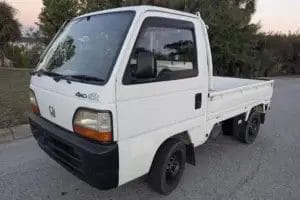
Why Japanese kei trucks are quietly becoming the most useful tool on the American homestead
You’ve seen them floating around Instagram and Pinterest lately. A tiny, boxy Japanese truck parked next to a woodpile, or hauling hay bales down a muddy two-track.
Maybe you thought it was cute. Maybe you filed it under “things I’ll never actually do.”
Here’s the thing: it’s not a trend. It’s a tool — and for anyone managing land, it might be the most practical vehicle you’ve never considered.
What Is a Kei Truck?
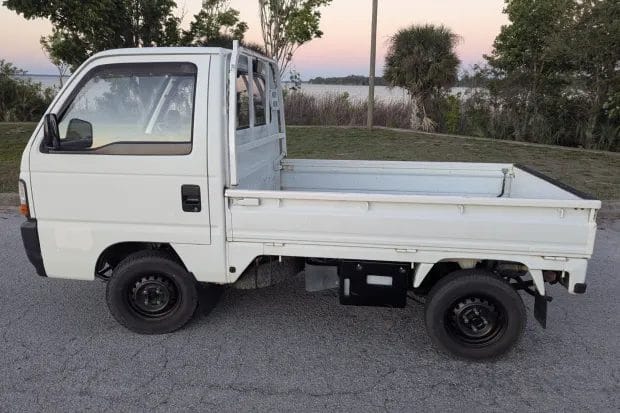
Kei (pronounced “kay”) trucks are Japan’s smallest class of road vehicle — built under strict government regulations that limit them to roughly 11 feet long, 5 feet wide, and a 660cc engine. That’s a displacement smaller than most chainsaws.
They were engineered for Japan’s narrow mountain roads and tight farm lanes, which means they were purpose-built for exactly the terrain most homesteaders deal with every day.
The five main brands you’ll encounter are Suzuki Carry, Daihatsu Hijet, Honda Acty, Subaru Sambar, and Mitsubishi Minicab — each with a loyal following and distinct mechanical personality.
The ones coming into the U.S. now are almost all from the 1990s, thanks to a federal rule that allows vehicles 25 years or older to be imported without meeting modern safety standards.
That’s brought a wave of well-preserved, low-mileage working trucks out of Japanese farms and warehouses and onto American homesteads.
Why Homesteaders Are Choosing Kei Over Everything Else
The Bed That Changes Everything
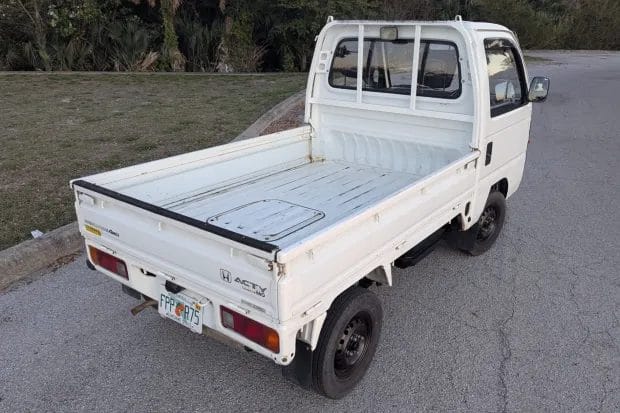
The defining feature of a kei truck isn’t the engine or the 4WD — it’s the bed. Specifically, the three-way folding bed that opens on all three sides, converting the truck into a true flatbed in seconds.
Loading hay bales from the side with a tractor bucket? Done. Sliding lumber in from the left when there’s a fence on the right? Done. Backing up to a raised platform and rolling materials straight across? Done.
A modern F-150 gives you one tailgate and 56 inches of width between the wheel wells. A kei truck gives you a full 56-inch-wide open flatbed from ground level, with a bed height of about 11 inches — low enough to load by hand without a ramp or a pulled back.
For solo operators doing everything themselves, that matters more than horsepower.
It Goes Where Your Big Truck Destroys Things
A fully loaded kei truck weighs roughly 2,200 lbs. An F-150 with a payload approaches 7,000 lbs. That difference is the difference between driving across a wet pasture in April and staying home.
Soil compaction is real. Heavy equipment on saturated ground compacts root zones, kills grass, and creates ruts that take seasons to recover.
Kei trucks — especially on wider AT tires — distribute weight so lightly that many owners haul firewood and feed through conditions that would put their tractor in the mud.
They also fit. A kei truck can drive between orchard rows, through a standard 8-foot gate, into a livestock barn, up a narrow forest track. Full-sized trucks don’t get these invitations.
The Math Nobody Talks About
| Vehicle | Purchase Price | MPG | What It Can’t Do |
|---|---|---|---|
| New half-ton pickup | $55,000+ | 15–20 mpg | Navigate tight spaces, survive mud season without damage |
| New UTV (Polaris Ranger) | $18,000–$28,000 | 15–20 mpg | Enclosed cab, highway speed, real bed, 40+ year lifespan |
| Used kei truck (4WD, AC) | $7,000–$12,000 | 35–45 mpg | High-speed highway, heavy towing |
A well-maintained kei truck from the 1990s has a realistic 200,000+ mile engine life. These were commercial vehicles — delivery trucks, farm haulers, fire support rigs — maintained under Japan’s strict vehicle inspection system (shaken) that requires regular professional service to stay road-legal.
Many arrive in the U.S. with under 40,000 miles.
Four-Wheel Drive That Actually Works
Most 1990s kei trucks came with selectable 4WD and a two-speed transfer case — high and low range — plus optional rear differential locks on agricultural variants.
The Honda Acty “Attack” model was specifically tuned for farm crawling, with ultra-low gearing that lets you haul slowly through wet ground without breaking traction.
This isn’t UTV-grade 4WD that gets you through a puddle. This is the same mechanical setup used in Japanese mountain agriculture for three decades.
Which Kei Truck Is Right for Your Homestead?
Suzuki Carry — The baseline. Easiest to find, cheapest parts, largest community. Front engine under the seat. If you’re new to kei trucks and want a simple, reliable workhorse, start here. Best for: general hauling, firewood, fencing, small property.
Daihatsu Hijet — Toyota engineering behind the scenes. The Jumbo cab version adds meaningful interior room, which North American-sized adults appreciate. Dump bed versions are common and practical. Best for: properties where you’re constantly moving material — gravel, compost, wood chips.
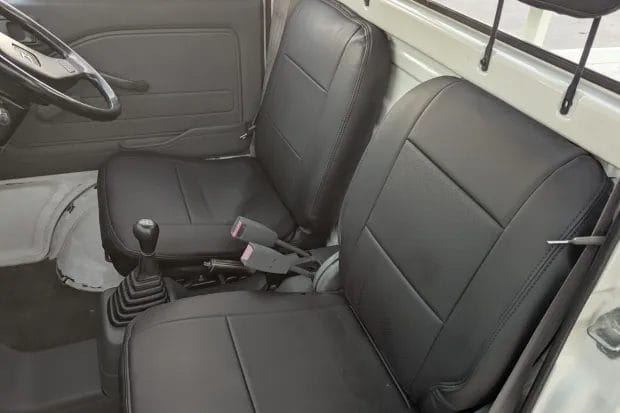
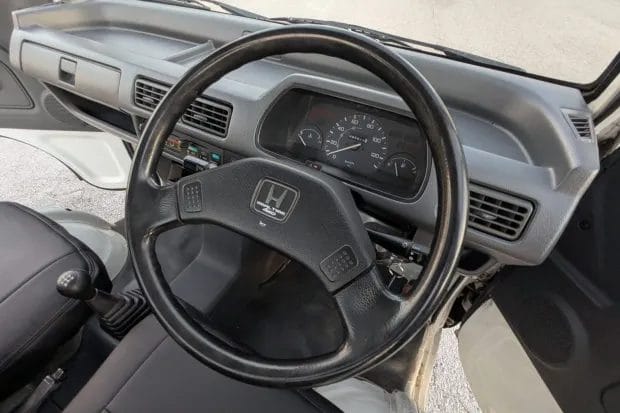
Honda Acty — Mid-engine layout with the engine just ahead of the rear axle. Exceptional traction when the bed is loaded. The “Attack” trim was literally designed for farmers. Best for: steep or rough terrain, orchard and row crop work.
Subaru Sambar — Rear-engine, four-cylinder, the smoothest and quietest of the group. Feels more like driving a car. Best for: operators who use it daily and want a more refined experience.
Mitsubishi Minicab — Solid 4WD systems, slightly harder to find parts for. Best for: hilly terrain, anyone who finds a clean one at a good price.
What You Need to Know Before You Buy
The 1990 Engine Transition Matters
Pre-1990 kei trucks have 550cc engines producing around 35 hp. They’re slower and less capable.
Post-1990 trucks upgraded to 660cc engines making up to 64 hp — a meaningful jump for loaded hauling and moderate grades. If you’re shopping for a working homestead truck, target 1991 or newer.
Immediate Service Items
These trucks are 25–35 years old. Budget for a baseline service before you work it.
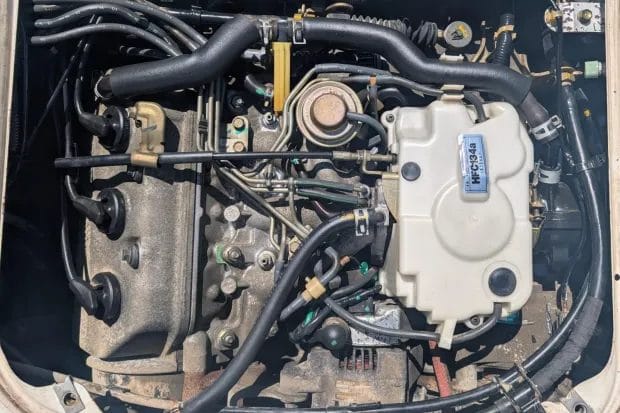
The timing belt and water pump should be done immediately unless you have documentation — a broken belt is engine death. The cooling system needs a flush since small radiators with long hose runs are prone to air pockets and clog over decades.
On carbureted models, plan on replacing the vacuum lines, which are a web of brittle rubber that cracks with age and causes rough idling. Finally, do a thorough underbody inspection — northern Japanese trucks from Hokkaido can hide frame rust under fresh undercoating.
Parts Are More Available Than You Think
The kei truck parts market in the U.S. has matured significantly. Specialty suppliers like G&R Imports and Oiwa Garage stock common service items domestically.
Filters, plugs, belts, and gaskets are readily available. Many components cross-reference to U.S.-market Suzuki models — Samurai and Geo Metro parts share dimensions with the Carry — which means you can often source at a local parts store with the right cross-reference numbers.
The Legality Question (Answered Honestly)
State laws on kei trucks vary widely and have been shifting. Here’s where things stand as of 2025.
In states like Texas, Indiana, Montana, and Wisconsin (with collector plates), kei trucks are broadly legal — register and drive like a normal vehicle. In Illinois, Missouri, and Minnesota, registration is restricted but varies by county or local ordinance.
In Georgia, Oregon, New York, and New Jersey, registration is banned outright, with some states actively revoking previously issued plates.
The honest bottom line for most homesteaders: if the truck lives on your property and works your land, no registration is required in any state. You don’t need plates to haul firewood, move hay, check fencing, or plow your driveway.
Registration only matters if you’re driving it on public roads. For most rural homesteaders, a kei truck earns its keep entirely on private land — and that’s legal everywhere.
What $8,000 Gets You That $28,000 Can’t
A used UTV gives you open sides, a CVT belt that needs regular replacement under load, and plastic body panels. It tops out around 45 mph and gets UTV fuel economy.
A kei truck gives you a fully enclosed steel cab with a heater (and usually AC on post-1995 models), a gear-driven manual transmission built for commercial service life, 35–45 mpg, and a vehicle that was mechanically designed to last decades of daily use.
In a Wisconsin winter, the difference between an open UTV cab and a heated steel cab isn’t comfort — it’s whether you’re actually going to use it in February.
The Part Nobody Writes About: It Changes How You Work
Talk to anyone who’s owned a kei truck on a homestead for more than a season and they’ll say the same thing: it changed how they thought about their property.
When your land tool is a full-sized pickup, you plan trips. You batch tasks. You don’t move six fence posts because it’s not worth firing up the truck. You don’t haul a half-cord of wood because you’re waiting to fill the bed.
A kei truck is cheap enough to run that you stop thinking about it as a truck. You start treating it like a wheelbarrow with 4WD. You grab one thing, move it, grab another. The property starts to feel smaller and more manageable.
That shift — from batched truck trips to continuous low-friction movement around your land — is worth more than any spec sheet comparison.
Where to Find One
The most active market is Facebook Marketplace — search by model name (Suzuki Carry, Honda Acty, Daihatsu Hijet, Subaru Sambar). Bring a Trailer has documented, inspected examples at higher prices but with better history.
The Minitrucktalk.com forums are the most knowledgeable buyer community online, with a classified section and regional recommendations. Dedicated importers like G&R Imports source directly from Japan and deliver fully serviced trucks at a premium.
Target 1991–1998, 4WD, manual transmission, under 60,000 km. Budget $7,000–$12,000 for a clean working truck. Anything significantly cheaper deserves extra time on the frame and timing belt history.

Davin is a jack-of-all-trades but has professional training and experience in various home and garden subjects. He leans on other experts when needed and edits and fact-checks all articles. Also an aspiring cook we he researches and tries all kinds of different food recipes and shares what works best.